Learn physics faster than re-reading your notes
Write your solution, get graded like a TA in seconds, and let spaced repetition bring each topic back right before you’d forget it. One loop — solve, get feedback, get reviewed — run by an algorithm built for retention, not a study planner you have to babysit.
Upload your study material
A photo, PDF, or scanned chapter — problems come out ready to solve.
Quantum_Mechanics_Ch4.pdf
A walk through the loop — the real thing, shown for illustration.
Trusted by students from




Simple, honest pricing
One plan, two ways to pay for it. Cancel anytime.
Monthly
Pay as you go
€14,95/ month
- Unlimited AI solution reviews
- Spaced review scheduling (FSRS)
- Full library of textbook problem sets
- Progress tracking across every topic
Yearly
Best value
€12,50/ month
Billed as €150 once a year
- Unlimited AI solution reviews
- Spaced review scheduling (FSRS)
- Full library of textbook problem sets
- Progress tracking across every topic
Why this beats re-reading your notes
Three well-established facts about learning — retrieval practice, spacing, and desirable difficulty — wired directly into the grading loop, not bolted on as a reminder email.
Matched to your edge
Your Elo rating keeps every problem in the 60–85% predicted-success zone — hard enough to move the needle, never a coin flip or a freebie.
Timed to your forgetting curve
FSRS — the same scheduling family behind the best spaced-repetition apps — resurfaces a topic right before you’d lose it, tuned for 90% retention.
No skimming past the fix
Miss a concept and Review won’t move on until you explain the correct approach in your own words — and the AI checks that it actually holds up.
Never the same problem twice
Run out of fresh problems on a due topic and the AI writes a new variant on the spot — same method, different numbers, so you can’t just memorize an answer.
Built for serious students of physics
Not a homework solver. A deliberate practice tool for building genuine physical intuition.
Ch. 7 · Problem 7.48 — Lagrangian Gauge Invariance
Your Attempt
“An excellent, rigorous, and complete proof… the student handles the chain rule, the independence of variables, and the commutativity of mixed partials with full precision.”
Ch. 13 · Problem 13.5 — Bead on Helical Wire
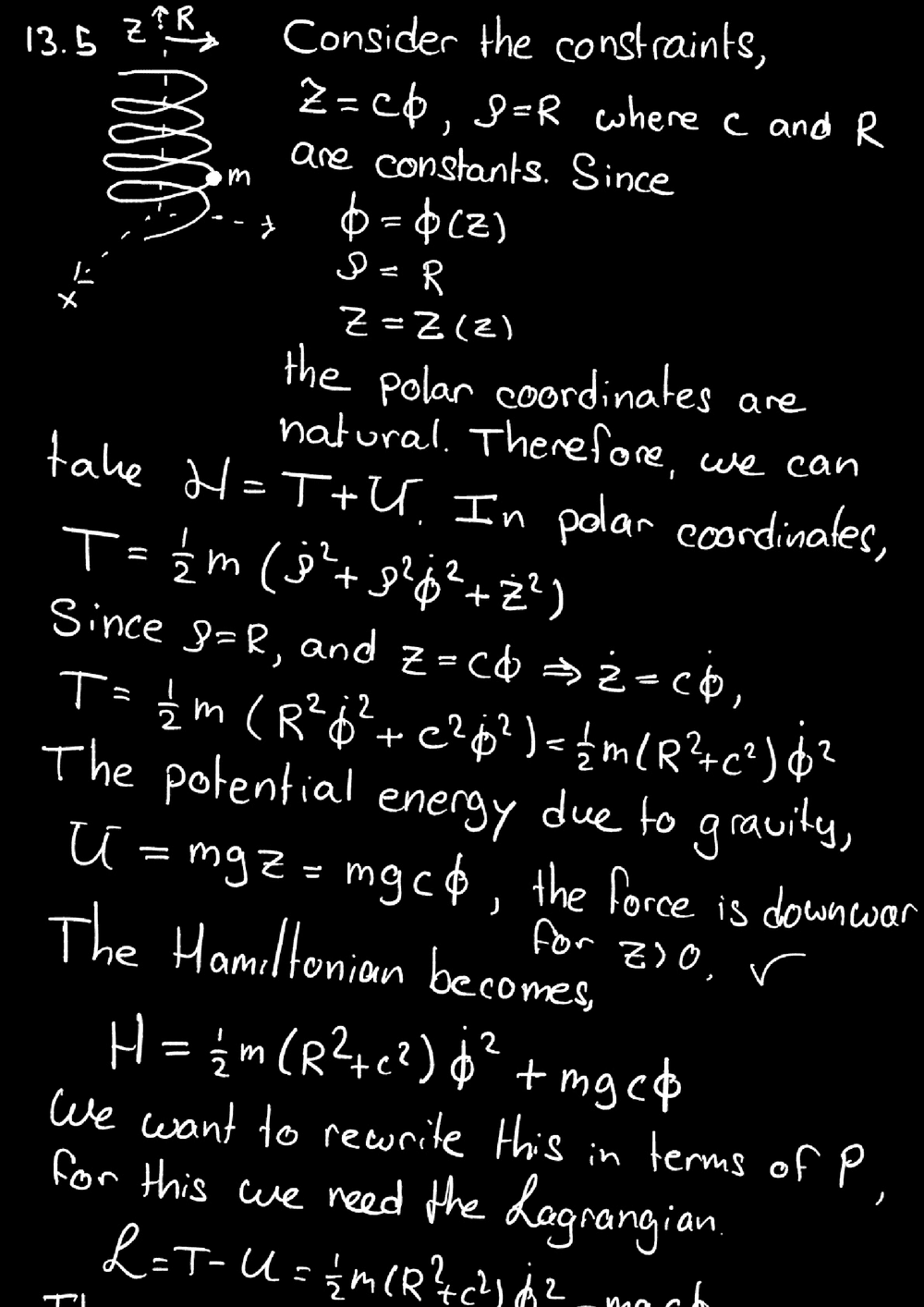
“An excellent, complete solution… goes beyond the requirements with sensible limiting-case checks and dimensional analysis, showing strong physical intuition.”
Submit Your Solution
Sketch a diagram or work through the algebra directly with a stylus or mouse.
LaTeX-native input
Write problems exactly as they appear in textbooks, with a live rendered preview. Supports inline math, display equations, and bare formulas.
AI solution review
Upload your handwritten solution as a PDF or photo, draw it with a stylus, or type it in LaTeX. Claude reads each step, identifies errors, and explains the correct physical reasoning.
Progress tracking
Track your scores across mechanics, quantum theory, electrodynamics, and more. See patterns in your strengths and identify persistent blind spots.
See a real review, step by step
Not just a score. Every submission gets a full breakdown — what you got right, what to fix, and why — the same way a TA would mark it up.
Ch. 7 · Problem 7.48 — Lagrangian Gauge Invariance
Attempt 3 · Jul 15, 2026
The student correctly proves that the total time derivative of a function of coordinates only can be added to the Lagrangian without changing the equations of motion, computing both key terms and showing they cancel. The core logic is sound, though there are some notational sloppiness issues and a slightly circular framing at the start. Overall a strong and essentially correct proof.
What You Got Right
Correct strategy
The student correctly recognizes that the proof amounts to showing that dF/dt contributes equally to both sides of the Euler-Lagrange equation, so its net contribution vanishes. This is exactly the right approach.
Both key terms computed
The student correctly computes both the partial-derivative-with-respect-to-q term and the velocity term, showing both equal d/dt(∂F/∂q_i), which is the crux of the proof.
Correct use of the total time derivative operator
Expanding dF/dt = Σ_j (∂F/∂q_j) q̇_j is correct since F depends only on the coordinates, and the use of Schwarz's theorem to swap partial derivatives is valid.
Clean use of the Kronecker delta
The evaluation ∂q̇_j/∂q̇_i = δ_{ij} to collapse the sum in the velocity term is done correctly and cleanly.
Improvements
Circular/backwards logic in opening framing
The student begins by asserting that L' satisfies the Euler-Lagrange equations (writing ∂L'/∂q_i = d/dt(∂L'/∂q̇_i)) as if it were already known. The logical structure of the proof should be to compute the Euler-Lagrange expression for L' and show it equals the expression for L, not to assume L' satisfies the equations and then derive that L does.
Suggestion: Define the Euler-Lagrange operator EL_i(·) = d/dt(∂·/∂q̇_i) - ∂·/∂q_i. Show by linearity that EL_i(L') = EL_i(L) + EL_i(dF/dt), then prove EL_i(dF/dt) = 0 using exactly the two computations you already did.
Notational inconsistencies in the total derivative operator
The expression d/dt = Σ_j q̇_j ∂/∂q_j + ∂/∂q̇_j + ∂/∂t is written with the sum applied inconsistently — the ∂/∂q̇_j term should carry a q̈_j coefficient (and is inside the sum), and ∂/∂t should sit outside the sum. Though harmless here since F has no velocity or explicit time dependence, the operator as written is not correct.
Suggestion: Write d/dt = Σ_j (q̇_j ∂/∂q_j + q̈_j ∂/∂q̇_j) + ∂/∂t. Then note F depends only on coordinates so the q̈ and ∂/∂t terms drop, giving d/dt = Σ_j q̇_j ∂/∂q_j acting on F or its derivatives.
Missing explicit statement of the conclusion
The student concludes the equations of motion are identical, which is correct, but could more explicitly state that because the extra term contributes zero to the Euler-Lagrange expression, setting EL_i(L') = 0 yields exactly EL_i(L) = 0.
Mathematical Accuracy
The core computations are correct: both the ∂/∂q_i(dF/dt) term and the d/dt(∂/∂q̇_i(dF/dt)) term are correctly shown to equal d/dt(∂F/∂q_i), and they properly cancel. Minor notational errors appear in the total derivative operator, and the opening lines conflate assumption with conclusion, but arithmetic and the essential manipulations are sound.
Approach Quality
The physical and mathematical reasoning is fundamentally correct and demonstrates good understanding of gauge freedom in the Lagrangian. The only weakness is the logical framing at the start, which presents the result as an assumption rather than deriving it.
Set up in under a minute
Tell us what you're studying once — PhysicsTrack takes it from there.
What level are you studying at?
Helps us tailor things later.
Studying
Introduction to Electrodynamics
Griffiths · 4th edition
A preview of setup — the real thing, shown for illustration.
Topics covered
From first-year mechanics to graduate-level field theory.
Your library, mapped
Every textbook you add gets slotted into the curriculum — mastered topics collapse into checkmarks, active ones show your chapter progress, and the next suggested book is waiting right where it unlocks.
FOUNDATIONS · MASTERED
MECHANICS
Classical Mechanics
Goldstein
13 of 20 chapters
Nonlinear Dynamics and Chaos
Strogatz
Suggested
ELECTROMAGNETISM
Introduction to Electrodynamics
Griffiths
5 of 12 chapters
Classical Electrodynamics
Jackson
Requires: Introduction to Electrodynamics
QUANTUM
Principles of Quantum Mechanics
Shankar
4 of 21 chapters
Quantum Field Theory
Peskin & Schroeder
Requires: Quantum Mechanics
RELATIVITY
A First Course in General Relativity
Schutz
3 of 20 chapters
General Relativity
Wald
Requires: Special Relativity
Illustrative — your map fills in as you add textbooks and solve problems.
Behind the scenes
PhysicsTrack started as a way to actually understand physics, not just pass it.
We don't take ourselves too seriously, but we take your grades very seriously.




Ready to study with rigour?
Create a free account and submit your first solution today.
Get started free